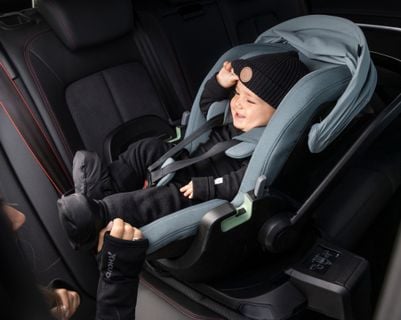
A baby smiling wide while sitting in a mid-blue Thule Maple infant car seat, mounted on the back seat.

Swedish Plus Test: One of the Toughest Car Seat Tests

The Swedish Plus Test is one of the toughest voluntary car seat safety tests. It focuses specifically on the forces placed on a child’s neck during a severe frontal collision. Only rear-facing car seats are eligible for the test.

In this guide, we’ll explain what the Swedish Plus Test is, how it works, and what passing the test means for a car seat.


Why the Swedish Plus Test matters

The Swedish Plus Test goes beyond standard car seat approval requirements, with a particular focus on protecting a child’s neck during a frontal collision. The test measures the forces placed on the neck of the crash test dummy, which must remain below specified limits for the car seat to pass.

History and development

The Swedish Plus Test was developed by VTI, the Swedish National Road and Transport Research Institute, in collaboration with the Swedish Traffic Administration. It was introduced to address the limitations of existing car seat safety tests, which often did not adequately assess the forces on a child’s neck during a collision. By introducing stricter criteria and more rigorous testing conditions, the Plus Test has revolutionized car seat safety standards.

Unique aspects of the Plus Test

One of the unique features of the Plus Test is its exclusive focus on rear-facing (RWF) seats. Extensive research has shown that rear-facing seats provide superior protection for babies and toddlers in a collision. The Plus Test reinforces this by only certifying RWF seats, advocating for their use as the safest option for young children.

Why rear-facing seats?

Rear-facing seats are designed to cradle the child's head, neck, and spine, distributing the forces of a collision across the entire body. This significantly reduces the risk of serious injuries. The Plus Test’s endorsement of RWF seats underscores their importance in safeguarding young passengers.

The importance of neck force measurement

The head and neck are subjected to immense forces during a frontal collision. This can be particularly dangerous for children, whose neck muscles and spinal bones are not fully developed, while their heads are relatively bigger and heavier. The Plus Test’s focus on neck force measurement ensures that certified car seats offer the best protection in this critical area, minimizing the risk of life-threatening injuries.

Benefits of Plus-Tested Car Seats

Car seats that pass the Swedish Plus Test are considered the safest on the market. They offer several benefits:


- Superior safety: By meeting the strict criteria of the Plus Test, these car seats provide unmatched protection in severe collisions.
- Peace of mind: Parents can be confident they’re using one of the safest car seats available, ensuring their child's well-being.
- Advocacy for rear-facing seats: Plus-tested car seats promote the use of rear-facing seats, which are proven to be safer for young children.


Thule car seat attached to a testing rig at the Thule Test Center.
Thule Elm toddler car seat being inspected at the Thule Test Center.

Commitment to safety: The Thule example

At Thule, child safety is a top priority. We are proud to say our Thule Elm rear-facing car seat has passed the stringent Swedish Plus Test. This certification highlights our commitment to providing children with the safest possible travel solutions. Our car seats are designed with advanced safety features, rigorous testing, and exceptional comfort, ensuring peace of mind for parents and protection for children.

Conclusion

The Swedish Plus Test is a testament to the highest standards of car seat safety. Its rigorous methodology and focus on critical safety parameters, particularly neck force measurement, make it the ultimate benchmark in the industry. By choosing a Plus-tested and approved car seat, parents can ensure they are providing the best possible protection for their children, reinforcing the importance of safety on every journey.


Explore